
Expressive STEM Centers in Central Texas: A Research Collective Learning to Empower Community Imagination and Creative Confidence
Project Summary
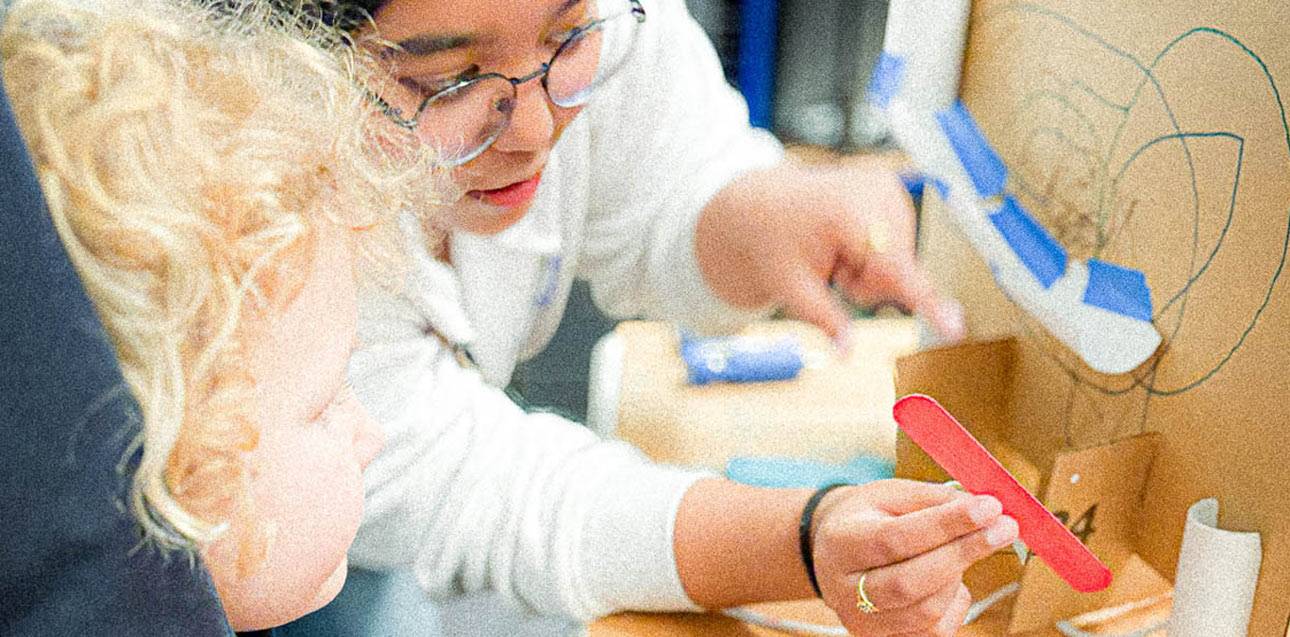
The Expressive STEM Centers project (NSF Award Abstract #2517055) creates family-driven learning networks that honor shared knowledge and experience while building confidence with technology and science. By positioning libraries and community centers as hubs for intergenerational innovation, this project transforms how informal STEM learning happens. Rather than treating STEM as separate from daily life, the project uses a material inquiry approach where families explore robotics, coding, circuits, and environmental science by connecting powerful tools to heritage stories and real-world challenges.
This research project examines how imagination and creative confidence develop through hands-on learning, and whether family-based STEM experiences can create lasting changes in how communities envision their futures. The Expressive STEM Centers Research Collective employs Participatory Action Research methodology, combined with material inquiry approaches, to investigate how expressive STEM learning fosters imagination and creative confidence across intergenerational family networks.
Over three years, the project will conduct approximately 160 formal events (playshops, afterschool clubs, scientist roundtables, community science activities) plus 230 DIY drop-ins across three community sites, including the San Marcos Public Library, Centro Cultural Hispano de San Marcos, and The Meadows Center for Water and the Environment. Using data from micro-interviews, video documentation, exit surveys, ethnographic field notes, and participant-curated digital portfolios, researchers will track how moments of imagination during hands-on STEM learning spread through families and communities over time.
The research investigates three core questions: (1) how intergenerational family-focused expressive STEM learning generates sustainable multimodal STEM literacies, (2) how emergent creative confidence disrupts conventional thinking about family and community capacities for learning, and (3) how engaging in community research affects belongingness for individuals and communities.
Outcomes include evidence-based frameworks for community-driven STEM learning, a replicable catalog of expressive STEM activities, participant micro-credentials documenting research and facilitation skills, and scholarly publications that advance understanding of imagination’s role in informal STEM education.
Project Resources
Project Leads
Principal Investigator

Sean Justice, Ph.D.
Associate Professor,
School of Art and Design, College of Fine Arts and Communication - Texas State University
sbj19@txstate.edu
-
Co-Principal Investigators
Lori C Assaf, Ph.D.
Associate Professor, Department of Curriculum & Instruction
lassaf@txstate.eduAdetty Ramos Pérez de Miles, Ph.D.
Associate Professor, School of Art & Design
adetty@txstate.eduShelly Forsythe, Ph.D.
Associate Professor, Department of Curriculum & Instruction
mforsythe@txstate.eduAndrew Rechnitz
Assistant Vice Provost, Creative Technologies & Media Engagement
anr209@txstate.edu -
Community Leads
Gloria Salazar,
Centro Cultural Hispano de San Marcos
Ashley Schimelman,
San Marcos Public Library
Funder
This project is funded by the U.S. National Science Foundation (Award Abstract #2517055).