
SLEA
Student Leadership in Environmental Action Program
The Student Leadership in Environmental Action (SLEA) Program empowers high school students to tackle real-world environmental challenges by designing projects using Texas Stream Team water quality monitoring protocols and/or data. Whether addressing water quality issues, restoring ecosystems, or raising awareness about environmental threats, participants will develop actionable solutions while gaining valuable leadership experience.
Students interested in submitting a project must follow the program guidelines outlined below and meet the annual deadline of April 1. All participating students will receive an SLEA certificate of recognition and an invitation to attend a virtual networking event with other SLEA participants.
Project Requirements
The SLEA Program is open to high school students who are either trained or familiar with Texas Stream Team Community Scientist trainings. Students may work individually or in groups.
Use the Texas Stream Team Datamap to select an active monitoring site within your community.
- Conduct a minimum of one monitoring event at your site. Students who are not certified must conduct monitoring with a certified Texas Stream Team mentor. Try to visit your site more than once!
- Identify an environmental challenge affecting your site.
- Determine who is responsible for the site (such as a landowner, local municipality, or business) and write a formal letter or email outlining your recommendations.
- Create a presentation or video that summarizes the project and includes a personal reflection on the experience.
Presentations may be submitted in your preferred format, such as a short video, poster presentation, PowerPoint, Prezi, or ArcGIS Story Map.
Submit your project through the Texas Stream Team online portal by April 1.
Review detailed project requirements here.
How will the project be recognized?
Participants will receive an SLEA certificate and an invitation to a virtual networking event. With permission, select projects may also be featured on the Meadows Center's website and social media.
General Information
-
Resources
- Project Requirements
- Letter Template (may be used for email)
-
High School Aquatic Science TEKS
The student knows about the interdependence and interactions that occur in aquatic environments. The student is expected to:
(B) identify biological, chemical, geological, and physical components of an aquatic life zone as they relate to the organisms in it.
(C) identify variables that affect the solubility of carbon dioxide and oxygen in water.
(D) evaluate factors affecting aquatic population cycles such as lunar cycles, temperature variations, daylight hours, and predator-prey relationships.
The student conducts short-term and long-term studies on local aquatic environments. Local natural environments are preferred over artificial or virtual environments. The student is expected to:
(A) evaluate data over a period of time from an established aquatic environment documenting seasonal changes and the behavior of organisms.
(B) collect and analyze pH, salinity, temperature, mineral content, nitrogen compounds, dissolved oxygen, and turbidity data periodically, starting with baseline measurements.
The student knows the origin and potential uses of fresh water. The student is expected to:
(A) identify sources of water in a watershed, including rainfall, groundwater, and surface water.
(B) identify factors that contribute to how water flows through a watershed.
(C) analyze water quantity and quality in a local watershed or aquifer.
The student understands how human activities impact aquatic environments. The student is expected to:
(D) analyze and discuss how human activities such as fishing, transportation, dams, and recreation influence aquatic environments.
Project Showcase
-
2026 Projects
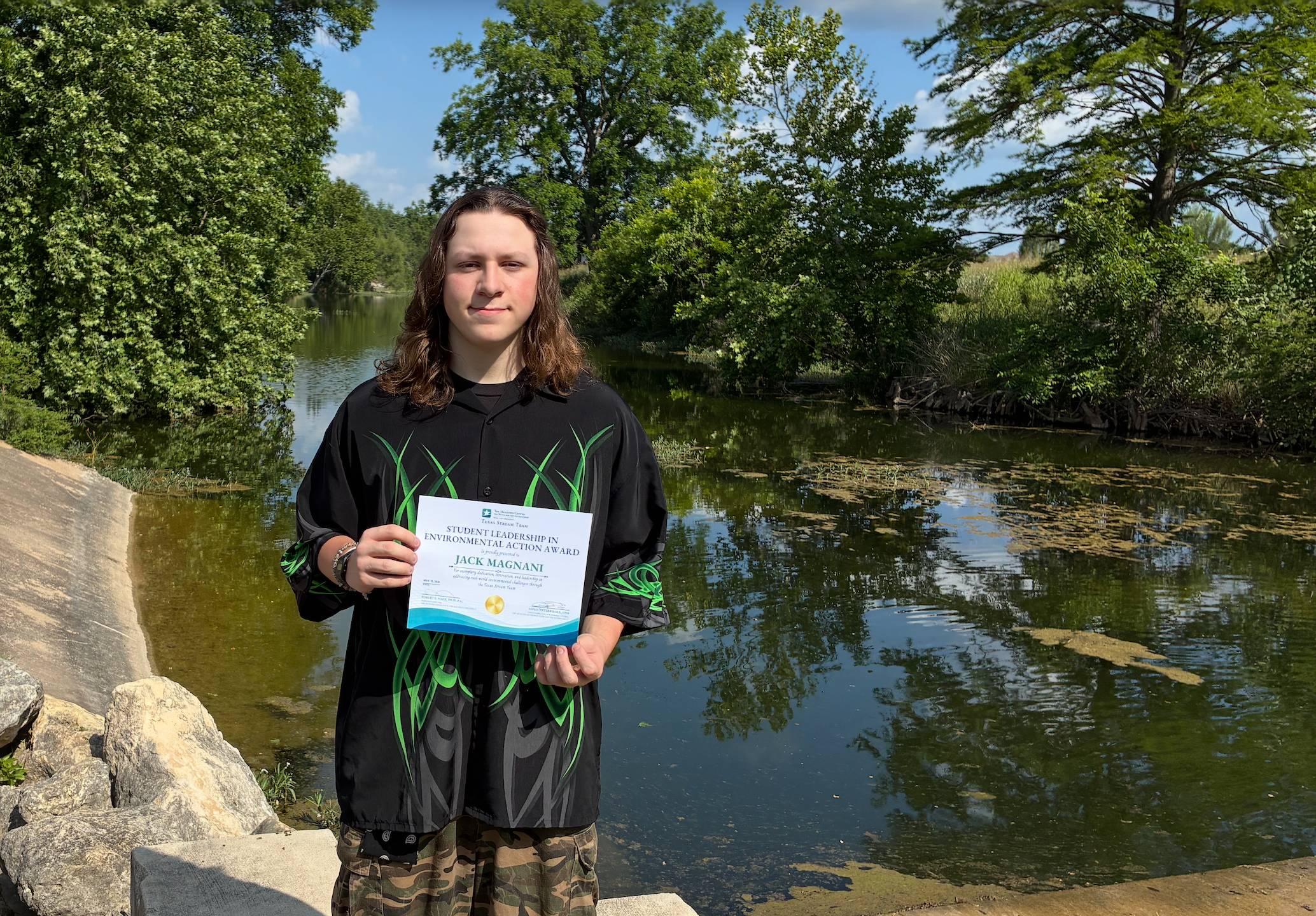
Jack Magnani - Dripping Springs High School
-
2025 Projects

Mack Emmerson - Dripping Springs High School
FAQs
-
I’m a high school teacher/parent seeking information about how to get my students’ Standard Core or Riparian Evaluation certified. Where do I look?
-
I’m a high school teacher looking to connect with local community members to pair my students with for monitoring events. Where can I find this information?
-
I’m not a high school teacher, but I work with high school students in a different capacity. Where do I begin?
- We recommend becoming certified to lead Texas Stream Team Water Quality Community Scientist Trainings, allowing you to certify the students you work with.
- You may also reach out to a nearby trainer to certify your group and begin monitoring.